
Copywriting with Artificial Intelligence Without Losing the Soul

More than twenty years ago, my life revolved around theology books and face-to-face communication in a Cuba where internet access was little more than a distant dream. Back then, my work taught me the most valuable lesson a copywriter can learn: writing is not about putting words together, but about connecting people. Communication was a constant exercise in empathy. You had to understand the audience’s pain points and offer solutions that resonated with their reality.
Over time, I traded the pulpit for the screen. I founded my first business and published my first web articles. For two decades, my process barely changed: sitting in front of a blank page and refining each paragraph over weeks. If I wanted volume, I had to outsource. And that’s where the real challenge began—reviewing texts that were technically correct, but lacked my voice, my perspective, my way of seeing the world.
The 2022 Click: Reconnecting with Words
At the end of 2022, everything changed. Generative artificial intelligence didn’t feel like a threat to me—it felt like efficiency rediscovered. While many colleagues feared that AI-assisted copywriting would kill the profession, I saw the assistant I had always wanted: one capable of processing massive amounts of information and building solid structures at lightning speed.
Going from forty hours of “analysis paralysis” to sixty minutes of uninterrupted creative flow isn’t magic—it’s method. But technology without judgment produces mediocre results: cold, technical texts with no nuance, incapable of holding a reader’s attention.
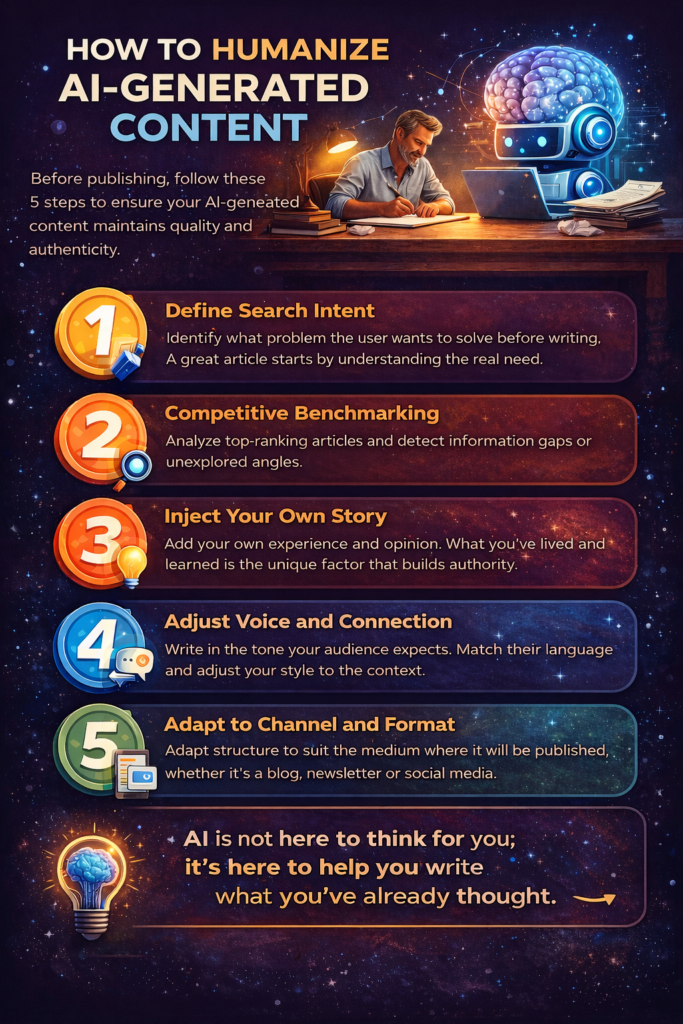
“AI isn’t here to think for you; it’s here to help you write what you’ve already thought.”
I never accept the first output. I evaluate, question, and edit with the same critical eye I had at the beginning of my career. AI handles structure and synthesis; I handle intention and final quality.
Why AI Needs an Architect, Not Just an Operator
If you let AI write on its own, you end up with generic content and zero competitive differentiation. Modern search engines prioritize authority and real experience (E-E-A-T)—elements a machine cannot replicate by itself.
The secret to successful automated copywriting in 2026 lies in strategic design before writing. Without it, technology is powerful but directionless.
My Roadmap: How I Humanize AI-Assisted Content in 5 Steps
To maintain quality and authority while scaling production, I apply a rigorous method designed to humanize AI-assisted writing. Each phase has a strategic purpose:
1. Search Intent Definition (The Compass)
Before writing, I identify what the user truly needs to solve. I analyze market data to understand the real demand behind a query. I’m not chasing keywords—I’m addressing problems.
Why it matters: Without this step, content can be well written but irrelevant. If you don’t answer the user’s actual need, algorithms will ignore you.
2. Benchmarking and Competitive Analysis
I study the content already ranking at the top. Not to replicate it, but to detect informational gaps or unexplored angles. What questions did the top three results leave unanswered?
Strategic value: This defines the baseline Google already accepts and reveals how to add unique value that allows you to outperform competitors.
3. Inject Your Own Story
This is where the text comes alive. I integrate my trajectory, opinions, and personal experiences explicitly. This is the moment when AI steps aside and I take full control of the narrative.
Authority factor: Experience is the most valued signal for modern algorithms. It’s the one thing AI cannot fabricate—and the foundation of genuine trust with readers.
4. Voice Adjustment and Reader Alignment
I adapt language to speak directly to the reader. Whether I’m addressing an executive seeking fast solutions or an entrepreneur just starting out, the tone must fit their reality.
Impact on retention: Tone determines how long users stay. A correct message delivered in the wrong tone creates friction and drives people away.
5. Channel and Format Adaptation (Context Matters)
I tailor the content to the platform where it will be consumed. A long-form blog article is not read the same way as a quick email newsletter.
Contextual relevance: The channel shapes the reading experience. Adapting structure ensures the message is received comfortably and effectively.
From Generic Text to Author Copy: A Practical Example
Here’s how human intervention transforms an AI-generated base.
Original AI version:
“Artificial intelligence optimizes writing processes by increasing content production speed by 50%.”
Version with Story and ‘Seasoning’:
“After twenty years of writing sermons and articles by hand, watching AI structure my ideas in seconds gave me back time I thought was lost forever. It’s not just about speed—it’s about having a co-pilot that handles the heavy lifting so I can focus on what truly matters: the emotion behind the message.”
The difference isn’t style—it’s connection. One is a cold fact; the other invites the reader into a lived experience.
GEO and Authority: Writing So AI Can Cite You
In 2026, SEO has evolved into GEO—Generative Engine Optimization. The goal is no longer just ranking links, but becoming the reference source AI systems use when answering questions.
To be citable, content must be:
- Structured: Clear headings, lists, and tables that allow easy data extraction.
- Original: Insights, opinions, or data not found elsewhere.
- Direct: Clear, authoritative answers to complex questions.
Authenticity is the key. Machines synthesize information; humans create meaning. Technical optimization is the map—your voice is the destination.
Overcoming Fear: AI as a Strategic Ally
It’s common to hear that AI will replace human talent. In reality, it doesn’t replace copywriters—it empowers those who know how to integrate it intelligently. Fear of change becomes a brake, but in a saturated digital environment, these tools are essential for standing out.
Copywriting with Artificial Intelligence: Frequently Asked Questions (2026)
Do search engines penalize AI-written content?
No. They penalize low-quality, unoriginal content. When AI is used for structure and human experience is added, rankings remain strong.
How can I avoid robotic-sounding content?
Use layered editing: generate structure first, inject personal anecdotes second, and refine rhythm with short, punchy sentences last.
What defines an effective workflow in 2026?
A powerful language model for drafting, solid data analysis, and human editorial optimization to guarantee authority.
A Final Reflection
At the end of the day, the message is always yours. AI is just the instrument—like paper or the typewriter once were. Today, my writing is more productive than ever, and paradoxically, more personal too.
Will you keep watching technology with suspicion, or will you start directing your own digital strategy?
The blank page is no longer an obstacle—it’s an opportunity for your perspective to travel further than you ever imagined.