
Website Loading Speed: Why Your Business Loses Customers Before They Read the First Line

Website loading speed is often treated as a technical issue. Something you fix with tools, metrics, and charts. But in real life, it doesn’t work that way. For users, a website isn’t fast or slow based on milliseconds, but on feelings. On whether the page feels responsive, whether they sense that something is happening, or whether—sometimes without even realizing it—they feel they’re about to waste their time.
And when a website wastes your time, you do what everyone does: you close the tab and give your click (and your money) to the competition.
This article isn’t just about speed. It’s about UX, user psychology, and SEO, mixed the same way they are in real life. Because one always affects the other.
Why Website Loading Speed Matters More Than It Seems
When someone lands on a website, they don’t arrive with infinite patience. They arrive with expectations. They expect things to work as fast as everything else they use every day: social media, search engines, apps, videos. When that doesn’t happen, something breaks.
And it’s not the code that breaks.
It’s trust.
A slow website isn’t perceived as “this page is taking a bit longer.” It’s perceived as:
- Something’s off here
- This doesn’t work properly
- I don’t fully trust this
That’s pure UX. And also basic psychology: the human brain judges before it analyzes. Long before it reads the content.
Time Is Not Perceived Linearly
This is one of the biggest mistakes when we talk about performance: thinking that one extra second is just “a little more.” It isn’t.
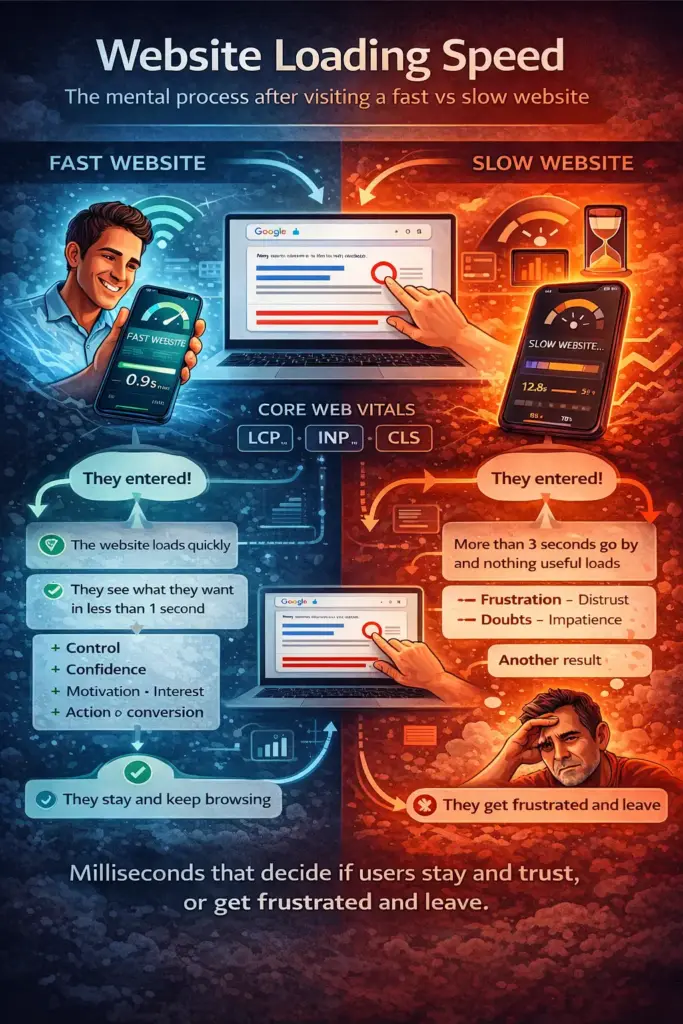
The brain works with thresholds:
- Under 100 ms: everything feels instant
- Around 1 second: the pause is noticeable but acceptable
- After 3 seconds: doubt appears
- More than 5–10 seconds: most people leave
Not because they’re impatient. But because while they wait, they think about another option. And almost always, that option is just one click away.
The Bias of the Person Who Designs Websites (Without Realizing It)
There’s something that happens very often when designing or developing a website.
We usually do it from:
- A good internet connection
- Fiber optics
- A powerful router
- A new computer
- A high-end smartphone
In that context, almost everything flies. And then we think: the website is fast.
But the website you build with a perfect connection doesn’t open out there under the same conditions.
It opens on:
- Old devices
- Mid-range or low-end phones
- Areas with unstable coverage
- Places where “5G” exists more in the icon than in reality
And the experience changes completely.
When the Connection Doesn’t Help: The Real User Experience
There’s something that teaches you a lot about website speed: experiencing it from the other side.
For years, browsing with a bad connection was normal for me in Cuba. Waiting a full minute for the first image to load. Sometimes it didn’t load at all. Learning what it feels like to stare at a blank screen, not knowing whether it’s going to load or not.
You might think: that happened because it was a different context. But then you change countries, infrastructure, and you realize something uncomfortable: it still happens.
Maybe not all the time. But it happens.
In small towns, indoors, during peak usage. The internet says it’s 5G, but the website freezes. Stuck. No feedback.
And that’s when the important thing happens:
- If it really matters to you, you wait
- If you think you can find it somewhere else, you leave
That’s everyday digital behavior. And there’s nothing irrational about it.
What a Fast Website Is Really For (Beyond SEO)
A fast website isn’t for showing off PageSpeed scores. It’s for not losing users before you even start.
From a UX point of view, a fast website:
- Reduces friction
- Creates a sense of control
- Maintains navigation flow
From user psychology:
- Reduces anxiety
- Prevents frustration
- Reinforces trust and reliability
And from a business perspective:
- More people actually read
- More people interact
- More people convert
A key idea here:
A fast website doesn’t help you gain users. It helps you avoid losing them.
Website Loading Speed and Conversion: Where the Money Is Lost
Many times, the problem isn’t that users don’t buy, sign up, or get in touch.
The problem is that they never even try.
Every second of loading adds a small friction. And frictions add up. When there are too many, the user leaves quietly.
No complaint.
No email.
No warning.
They just go.
That’s why website loading speed has a direct impact on conversion. Not because it persuades more—but because it doesn’t scare people away.
Why Google Is Obsessed With Speed (And It’s Not a Whim)
Sometimes SEO is talked about as if Google lived in a parallel world. But Google increasingly measures the same thing users feel.
Core Web Vitals are a good example:
- LCP: Do I see something useful quickly or not?
- INP: Does the site respond when I interact, or does it feel broken?
- CLS: Does everything move around and make me distrust it?
These aren’t isolated technical metrics. They’re the technical translation of a human experience.
If people arrive and leave, Google ends up reflecting that. Not as a punishment. But as logic.
How a Slow Website Breaks the Experience in Real Time
Users don’t wait while watching the clock. They wait thinking.
While the website loads, they:
- Open another mental tab
- Remember another result
- Consider alternatives
Waiting is not passive. It’s active.
And the more uncertain that wait is—blank screen, endless spinner—the worse it feels.
Mobile: Where Patience Is Even Lower
On mobile, everything is amplified:
- Less attention
- More distractions
- More urgency
If a website is slow on mobile, the problem isn’t technical. It’s experiential.
And today, for most projects, mobile is the main experience, not a secondary one.
Perceived Speed vs Real Speed
You can’t always make everything load in milliseconds. But you can make it not feel slow.
That’s where perceived speed comes in:
- Showing structure before content
- Giving immediate feedback
- Avoiding blank screens
Users don’t need everything to be ready. They need to feel that something is happening.
The Most Common Mistake: Optimizing for Google and Forgetting the User
Sometimes scripts, banners, popups, and widgets are added “for marketing” or “for SEO,” and the website becomes heavy.
Acceptable metrics.
Bad experience.
If users leave, Google eventually does the same.
Website Loading Speed Is Not an Extra — It’s the Foundation
You can have great content. Great design. A great strategy.
But if your website is slow:
- People leave
- The experience breaks
- The business feels it
On the internet, the winner isn’t the one with the best product, but the one who respects the customer’s time. Is your website up to their impatience?
Website loading speed isn’t a technical obsession. It’s a form of respect for the user’s time. And today, that’s everything.